
We are thrilled to announce the successful Bachelor’s thesis defense of Paula Feliu Criado, a talented student from the Degree in Artificial Intelligence program at the Universitat Autònoma de Barcelona (UAB).
For her final degree project, developed as part of our ERC-funded BIG-5 research, Paula set out to answer a big question: how do we show our connection to nature in the images we share on social media?
With guidance from the BIG-5 team, she built an innovative framework that helps uncover those connections at scale.
The Challenge: From «Extinction of Experience» to Digital Nature
As cities grow and digital lives expand, many of us are spending less time in nature. Researchers call this the “extinction of experience”, the idea that less contact with the natural world can lead to less appreciation and concern for it.
But could our digital habits also be part of the solution?
That’s what the BIG-5 project explores: how Digital Relational Values (DRVs), the emotional or symbolic connections to nature formed in online spaces, might actually help rebuild our bond with the natural world.
To study this, we need tools that can recognize and make sense of nature-related content across massive volumes of social media data. That’s where Paula’s work comes in.
Paula’s Solution: An AI That Can Explain Its Thinking
Paula created a smart, multi-layered AI system designed to do more than just spot nature in a photo. Her model classifies images based on four different criteria used by the human coding team at the BIG-5:
- Nature vs. Non-Nature: Is the image showing a natural scene?
- Biotic vs. Abiotic: Are living things present, like animals or plants, or is it more about landscapes and objects?
- Material vs. Inmaterial: Is the connection physical (like touching a tree) or more emotional or symbolic (like admiring a sunset)?
- Landscape type: Is it a forest, a lake, farmland, or something else?
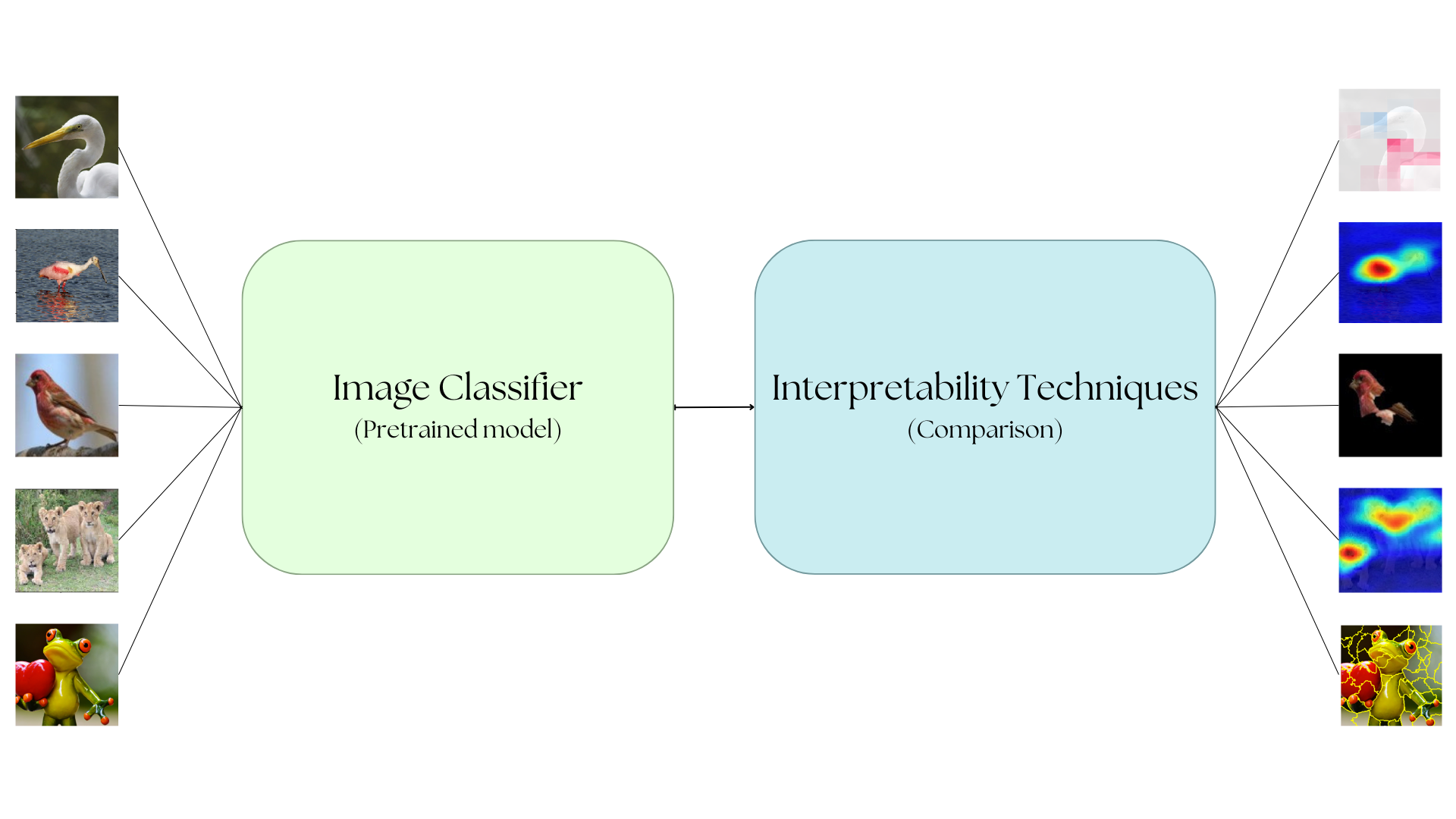
But accuracy isn’t enough. To really use this tool in research, we also need to understand why the AI makes the decisions it does. So Paula went a step further and tested several explainability methods, which are ways to open up the “black box” of AI and see what’s going on inside.
She found that techniques like Grad-CAM and LIME were particularly useful. They create visual “heatmaps” that show which parts of an image the AI paid attention to when making its decision.
Some of the insights were especially striking:
- For simpler tasks, like spotting whether nature was present, the AI zeroed in on key features like faces or animals.
- For more complex tasks, like identifying landscape types, it took in more of the scene, analyzing background elements like trees, grass, or buildings.
Why This Work Matters
Paula’s project adds real value to the BIG-5 mission. Here’s why: She showed that a lean, efficient model (ResNet-18) can handle complex, real-world images from social media without requiring tons of computing power.
Her AI system can be used as a pre-filtering tool, helping researchers sort through thousands of posts and focus on the most relevant ones.
And importantly, the explanations generated by the model give us new insight into how people express their connections to nature online, whether through selfies in the woods or sunset shots on a beach.
Paula didn’t just build a prototype, she built a working system that takes BIG-5 from idea to implementation. Her work lays the groundwork for large-scale, AI-assisted research into how we relate to the natural world in digital spaces, and how those relationships might help shape a more sustainable future.


