
Exploring Relational Values to Nature: Fulvia Calcagni at the GISCIENCE Colloquium in Zurich
On November 18th, 2025, our colleague and postdoctoral researcher for the BIG 5 project, Fulvia Calcagni, was an invited speaker at the renowned GISCIENCE Colloquium organized by the Department of Geography at the University of Zurich.
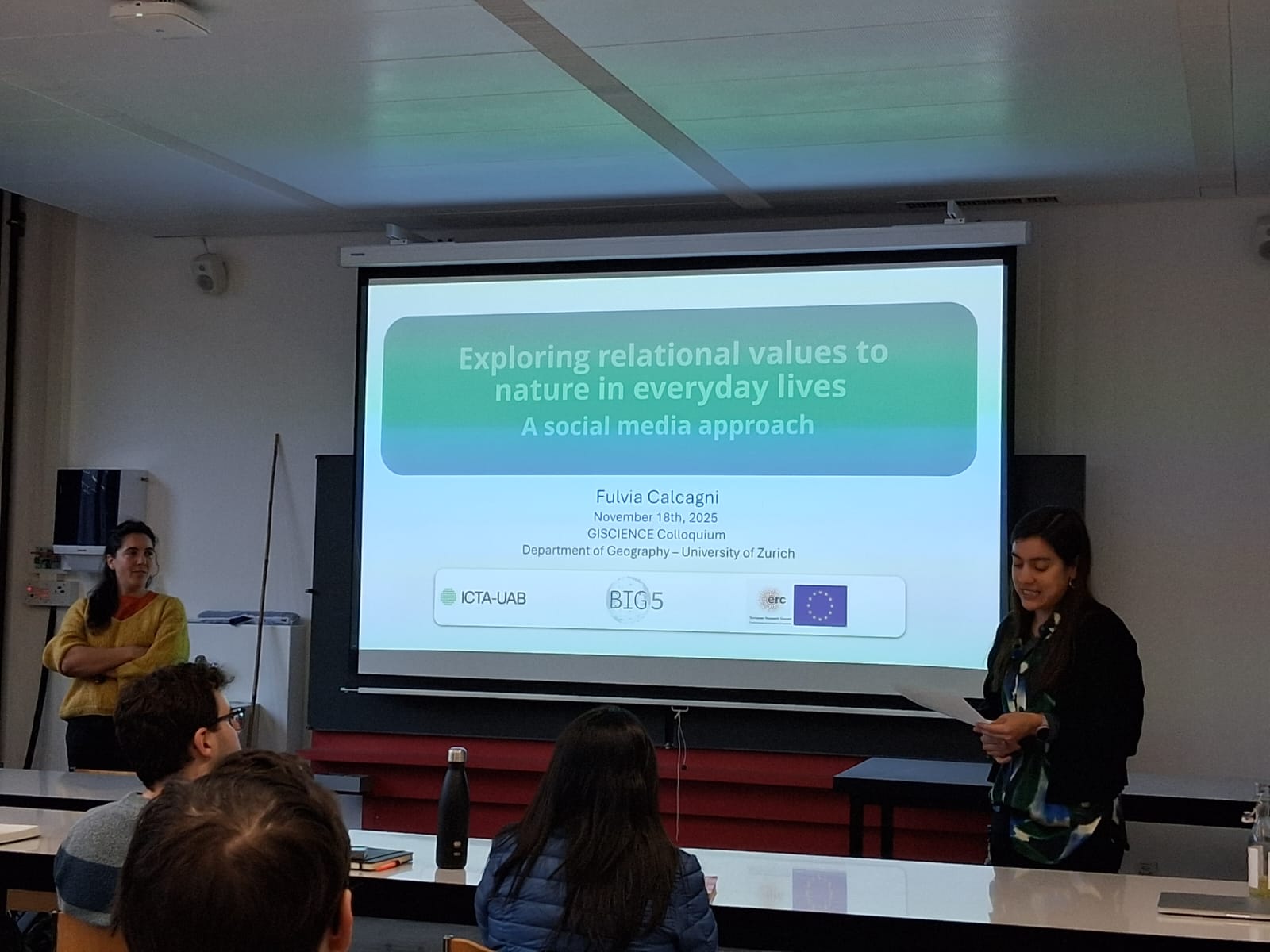

Under the title «Exploring relational values to nature in everyday lives: A social media approach,» Fulvia shared the most recent advancements of our research.
Nature in the Digital Age
The presentation started by highlighting the role of the utilitarian value system dominant in modern societies in underlying the structural and discursive conditions for the continued environmental degradation observed to date.
This pointed at the importance of looking at the relational as a dimension of values that, complementing the instrumental and inherent motivations to nature conservation, overcoming the nature/society dichotomy, and resonating with core values of justice, care and responsibility, constitutes the fundamental paradigm shift towards just and sustainable transformations. In addition, Fulvia drew on the digital environmental humanities scholarship to share the idea that nature – and the value we ascribe to it – can no longer be separated from the digital tools and media we use to observe, interpret and manage it.
In this context, social media (SM) emerges as a space where intangible, subjective, and context-dependent values are manifested and negotiated, providing them a relational dimension through the very act of sharing. Through functions like sharing, liking, and commenting, then, digital communities participate in a cycle of «Seeding, Grounding, and Spreading» of digital relational values.
Methodology and Digital Justice
A key point of the presentation was the work focusing on making the interpretation of this data replicable and rigorous by iteratively developing a coding protocol drawing on principles of netnography and grounded theory, and assessing agreement between the coders involved in the assessment.
Beyond data collection and coding, the research adopts a critical stance, rejecting the scientific objectivity of algorithmic epistemologies and paying attention to how dynamics of domination (such as gender, class, etc.), and their spatialities and temporalities, are revealed and reproduced in online spaces.
The presentation showcased spatial and temporal analyses that reveal significant differences in how various demographic groups experience nature. For instance, it discussed how spiritual, aesthetic, and recreational values vary between locals and non-locals, as well as gender differences in the use of urban green spaces.
Future Steps
To conclude, Fulvia outlined the ongoing work of the BIG 5 project, which includes:
- Extending the analysis to a global scale by applying Machine Learning techniques.
- Analyzing multiple popular platforms like Twitter/X, TikTok, and Weibo to reduce sampling biases.
- Cross-validating results with interviews to better understand the gap between expressed values and actual behaviors.
It was an inspiring session to debate how technology shapes our relationship with the environment.
We especially thank Dr. Maria Soledad Castro-Vargas, Prof. Dr. Christian Berndt and Prof. Dr. Ross Purves for the invitation and the warm hospitality.